
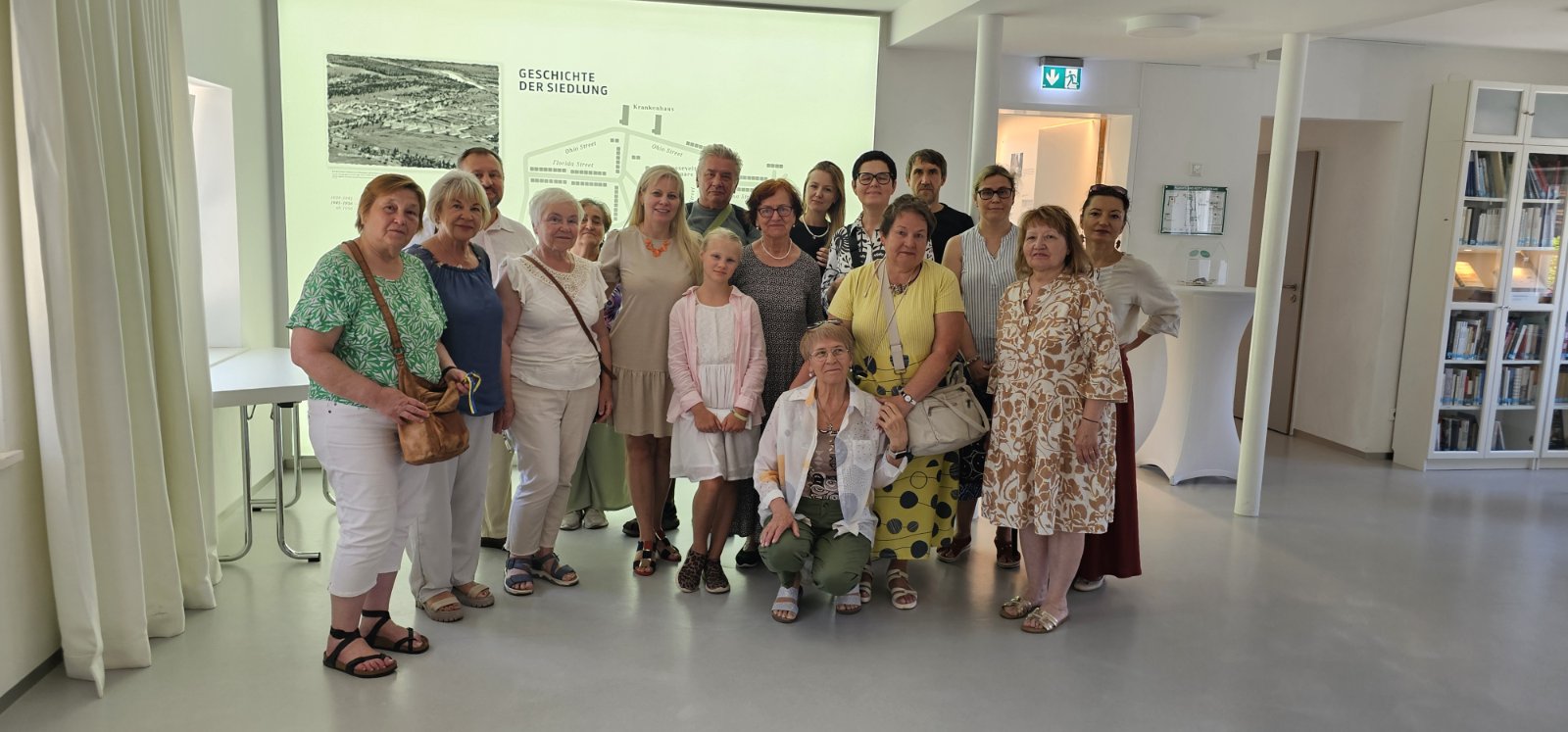
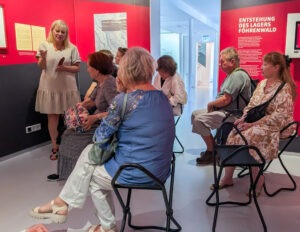
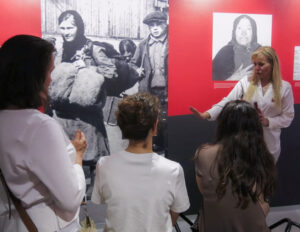
Over the past months, the BADEHAUS Place of Remembrance has welcomed several Ukrainian visitor groups. The tours were conducted in their native language by historian Prof. Dr. Olena Korzun, who presented the history of the site from a Ukrainian perspective.
© Olena Korzun
The focus was on the experiences and fates of Ukrainian forced labourers, as well as on flight, displacement, and new beginnings – themes that are deeply connected to the history of this place and that continue to hold personal significance for many Ukrainian families, as some have experienced war and displacement themselves.
© Olena Korzun
The groups included participants from several generations: from a twelve-year-old girl to visitors over the age of 70, travelling from Munich and Ingolstadt. Although their personal backgrounds and life stories differed greatly, the Ukrainian traces at this site touched everyone. The stories of forced labourers, uprooted families, and shattered lives prompted many participants to share their own family histories during the tour – stories of deportation, forced labour, and the loss of relatives during war.
This created an intense exchange between the visitors and the guides. The guests spoke about their families’ experiences, memories of the Second World War, and the close connection between the history of their homeland and broader European history. In this way, the museum became not only a place of historical learning, but also a space for listening, remembrance, and dialogue.
For many visitors, the experience was much more than a museum tour. Numerous guests recorded their impressions in the visitor book, describing how deeply they were moved by the stories connected to this place. The strong response demonstrates the importance of places of shared remembrance and dialogue.
© Olena Korzun
For Prof. Dr. Olena Korzun, it was precisely this intertwining of histories that made the encounters so powerful: “What touched us especially was this extraordinary ‘spiral of time and human destinies’ embodied in the history of the BADEHAUS itself — the way different historical layers, migrations, wars, forced displacement, and personal tragedies intersect within one physical space.”
The BADEHAUS Memorial will continue its collaboration with Prof. Dr. Olena Korzun and welcomes further Ukrainian visitor groups in the future. Because remembrance lives through dialogue – through bringing together different perspectives and experiences.